



One of the most common causes of back pain is osteochondrosis.According to statistics, around 80% of people suffer from this pathology.However, not all patients can accurately answer what osteochondrosis is.This is a chronic disease that affects the cartilage and bone tissue of the spine.Degenerative dystrophic changes can affect any part of the spine or several at the same time.
To get rid of the disease faster, it is necessary to start treatment when the first signs of pathology appear.However, many people simply do not notice them and then the pathology develops and becomes more serious.
Osteochondrosis must be treated comprehensively: medications, exercise therapy, physiotherapeutic procedures, etc.If there are complications (intervertebral hernia, radiculitis, leg paralysis), surgery may be necessary.
What is that
A chronic disease in which the intervertebral discs and bone tissue of the spine are damaged is called osteochondrosis.
The spine consists of 33-35 vertebrae, between which there are cartilaginous pads (vertebral disc).They are made up of a pulpous nucleus and a fibrous ring (external portion);they are covered on both sides by dense, elastic, vitreous hyaline cartilage.Thanks to the intervertebral discs, the spine becomes more elastic and mobile.
With osteochondrosis, metabolic processes and blood circulation in the spine are disrupted.Under the influence of negative factors, the discs between the vertebrae become less strong and elastic, and their volume decreases.The spine contracts and the height of the cartilaginous pads decreases.
The central gelatinous part of the disc first swells and then dries out, so spinal depreciation is impaired.The outer shell becomes thinner and cracks appear.When a gelatinous substance leaks there, bumps (bumps) form.When the outer part of the disc ruptures and the nucleus pulposus prolapses, an intervertebral hernia is diagnosed.
The disease osteochondrosis is manifested by discomfort, difficulty with mobility and pain in the affected area.When hernias appear, neurological disorders occur: back pain that spreads to the upper or lower extremities, numbness in the arms, legs, groin, involuntary urination or defecation, etc.
Help.Previously, osteochondrosis was diagnosed mainly in patients over 40 years old.Now the disease is increasingly detected in younger people (aged 16 to 30).This is often associated with a sedentary lifestyle.
Reasons
Degenerative-dystrophic changes in cartilage and bone tissue occur due to unequal load on the elements of the spine.Then, in areas with excess pressure, destruction of the intervertebral discs occurs.The pathological process can be caused by many negative factors.

The main causes of osteochondrosis:
- Injuries after a fall or blow.
- Congenital anomalies of the spine, genetic predisposition.
- Metabolic disorders due to poor nutrition, the appearance of excess body weight.
- Infectious diseases.
- Excessive stress on the spine during strength sports or heavy physical work.
- Chemicals that enter the body through food or air.
- Frequent vibrations, for example from drivers.
- Flat feet.
- Incorrect posture.
- Passive lifestyle, for example, among people with sedentary work (office workers, drivers).
- Smoking.
- Prolonged exposure to adverse weather conditions (low temperature and high humidity) on the body.
- Wearing anatomically incorrect shoes (tight or with heels).
- Frequent stress.
- Pregnancy, etc.
Often the disease manifests itself in people who carry heavy weights in one hand, stand in the wrong position for a long time, or sleep on an excessively soft mattress or high pillow.The likelihood of developing the disease increases with age-related changes associated with metabolic processes or blood supply to the vertebrae.This risk increases if a person frequently changes body position, bends, straightens or shakes the body.
Reference.Osteochondrosis is often diagnosed in people who are tall, slovenly and have a weak muscular corset.And also transporters, professional athletes, builders and office workers are also at risk.
Types of osteochondrosis
As already mentioned, the pathology can affect different parts of the spine.Depending on the location, the following types of osteochondrosis are distinguished:
- Lumbar disease is the most common type of disease, as the load on the lumbosacral segment is quite high.The pathology is accompanied by pain in the lower back, which can spread to the legs, groin, and in the later stages, neurological disorders occur (decreased sensitivity of the lower part of the body).
- Cervical - also common.Degenerative-dystrophic changes are associated with weakness of the neck muscles, therefore, even with minimal exposure, there is a risk of vertebral displacement.It manifests as pain, which can radiate to the upper limbs, headache, auditory and visual disturbances.
- Thoracic is the rarest form of pathology.This is due to the fact that the mobility of the thoracic segment is minimal;in addition, it is protected by the ribs, back and abdominal muscles.It is quite difficult to identify the disease, as its symptoms resemble those of other diseases.
And there is also osteochondrosis of several parts or the entire spine at the same time.This type of disease has the most severe course.
Reference.According to medical statistics, osteochondrosis of the lumbar segment occurs in 50% of patients, cervical – 25%, thoracic – up to 10%.In 12% of cases, several parts of the spine are affected at the same time.
Classification of osteochondrosis depending on its stage:
- Stage 1– the initial phase of the pathology, which is manifested by dehydration of the nucleus pulposus, a decrease in the height of the cartilaginous cushion and the appearance of cracks in its external part.Diagnosing the disease at this stage is very difficult, as there are no obvious symptoms yet.The patient feels slight discomfort in the injured area if he remains in a certain position for a long time or moves actively.The pathology has a slow course, latent form.It is discovered accidentally during an x-ray, MRI, or CT scan of the back.
- Stage 2– at this stage, the distance between the vertebrae decreases, the surrounding muscles and ligaments sag and the likelihood of protrusions and displacement of the spinal elements increases.The cartilage lining begins to deteriorate, which is accompanied by pain.In the absence of adequate therapy, displaced discs or vertebrae can compress nerve bundles, muscles and blood vessels.It is much easier to identify the disease at this stage.Complex conservative therapy is carried out.
- Step 3– the outer part of the disc is destroyed, protrusions and hernias form.Furthermore, the risk of subluxation increases and arthrosis of the intervertebral joints may occur.The patient feels intense pain, which can spread to the upper or lower extremities, and sensitivity is impaired (tingling or numbness).
- Stage 4– due to excessive flexibility of the joints of the spine, bone growths appear in the areas of contact, which is why the body tries to improve the fixation of neighboring vertebrae.Osteophytes often compress nerve bundles and damage elements of the spine.The risk of ankylosis increases, which leads to joint immobility.The patient develops intense pain, neurological disorders and has difficulty moving.If left untreated, he may become disabled.
Osteochondrosis is a chronic disease that is important to observe in time to prevent dangerous complications.
Symptoms
The first signs of the disease are discomfort and a feeling of stiffness in the affected area.The patient's back tires more quickly and pain occurs periodically.Then spinal osteochondrosis in adults is complemented by other symptoms.Clinical manifestations depend on the stage and location of the affected area.Therefore, patients need to know how the pathology of the cervical, thoracic and lumbar spine differs.This will allow you to notice warning signs in time and seek medical help.
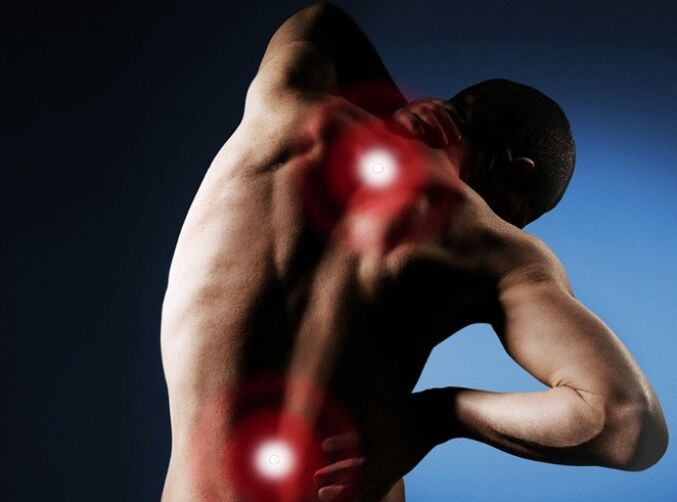
Symptoms of spinal osteochondrosis, which affects the cervical spine:
- aching or stabbing pain that may spread to the upper back, neck, or arms;
- increased muscle tone around the affected area, which can be felt on palpation;
- cephalgia, which intensifies during movement and is not relieved by analgesics;
- dizziness with sudden turns of the neck;
- visual impairment, which is manifested by “spots” or spots before the eyes;
- hearing disorders (noise or ringing in the ears);
- weakening of the neck or shoulder muscles;
- loss of sensation in the neck and hands;
- in rare cases, the patient's tongue becomes swollen and numb.
This type of pathology is most often observed in office workers.
Clinical manifestations of osteochondrosis of the lumbosacral segment:
- sharp or stabbing pain in the lower back;
- discomfort increases when the patient moves;
- pain syndrome can spread to the lower part of the body (buttocks, groin, legs);
- neurological disorders that manifest as numbness, tingling, coldness in the groin, buttocks, legs;
- weakening, thinning of leg muscles.
In some cases, due to severe pain, the patient is unable to straighten their back, turn around or bend over.He tries to adopt a position that alleviates the discomfort.
Degenerative-dystrophic changes in the thoracic segment of the spine are accompanied by the following symptoms:
- periodic sharp pain in the chest, shoulder blades, which intensifies when raising the upper limbs, bending over;
- pain becomes more pronounced at night, after hypothermia, physical exertion;
- impaired skin sensitivity;
- sensation of chest compression;
- During movement, a sharp pain may appear between the ribs.
Reference.Patients often confuse thoracic osteochondrosis with heart disease.However, during the first pathology, the pain intensifies with breathing and is not relieved by nitroglycerin.
When several parts of the spine are affected at the same time, specific symptoms appear.
Treatment methods
After the doctor diagnoses osteochondrosis, treatment must be started.The treatment plan is drawn up by the doctor, taking into account the degree of the disease, its causes and the patient's general condition.
During diagnosis, the following methods are used:
- Radiography.
- Computed tomography or magnetic resonance imaging.
- Ultrasound of the spine.
- Myelography.
- Neurological tests.
In addition, laboratory tests may be prescribed to the patient.
Treatment of spinal osteochondrosis should be comprehensive.Depending on the severity, it lasts from 4 to 8 weeks, then maintenance therapy is carried out for a long period (about a year).This will help consolidate the results and prevent relapses.
Your doctor will tell you what to do if you have osteochondrosis.Treatment usually begins with the use of conservative methods: taking medications, performing therapeutic exercises, physiotherapy, massage, etc.Surgical intervention is carried out only in cases where the pain does not disappear for a long time after drug treatment, there are neurological disorders or the disease is progressing rapidly.
Conservative methods will help eliminate pain and other unpleasant symptoms, normalize spinal functionality and prevent complications.
Medicines reduce the symptoms of the disease, improve blood supply and tissue trophism, and accelerate the healing of damaged areas.The following medications are used for this purpose:
- Anti-inflammatory medications help relieve inflammation and pain.
- Antispasmodics help relax tense muscles and relieve pain.
- Preparations with antioxidant effects, e.g. vitamin C, tocopherol, thioctic acid.
- To improve blood supply to the damaged area, vasodilators and B vitamins are used.
- To accelerate recovery or stop the development of degenerative processes, chondroprotectors, preparations based on hyaluronic acid, glucosamine and chondroitin are used.
Reference.The fight against intense pain is done with the help of therapeutic blocks.The medicine is injected into the affected area.If steroid medications are added to local anesthetics, the therapeutic effect will last longer.This method of therapy is used if traditional methods (medication, rest, physiotherapy) are ineffective.
The following conservative methods will help treat osteochondrosis:
- Physiotherapeutic procedures will help relieve pain and increase the effectiveness of medications.Furthermore, they are used during the period of remission, when there are no serious symptoms.The most commonly used treatments are ultrasound, laser treatment, magnetic therapy, diadynamic therapy, electrophoresis with the use of analgesics and anti-inflammatories.
- Therapeutic gymnastics helps to correct posture, strengthen the muscles of the back, abdomen, sides, ligaments, normalize muscle tone and relieve pain associated with compression of nerve bundles.Regular training will help improve blood circulation, nourish damaged spinal discs and speed up their recovery.
- Kinesiotherapy – safe exercises on special simulators.This technique allows you to remove the axial load from the spine, restores microcirculation in deep muscles, helps relieve pain, spasms, swelling and normalize the functionality of the damaged area.
Important.A set of exercises for osteochondrosis is compiled by the doctor for each patient individually.It is recommended to carry out training under the supervision of an instructor.

- Massage also helps fight osteochondrosis as part of complex therapy.Therapeutic procedures improve blood flow to the spine, relax spasmodic muscles and improve tissue trophism.A very popular aquatic body massage, which, in addition to the effects described above, normalizes the state of the nervous system.
- Manual therapy is the influence of the therapist's hands on the patient's body.Treatment methods are selected separately for each patient.After a course of treatment, blood circulation is normalized, metabolic processes in the damaged area are improved, its mobility is corrected and the immune system is strengthened.Manual therapy helps prevent complications of osteochondrosis.The main thing is to find an experienced specialist.
- Traction is the stretching of the spine using weights and special simulators.The procedure helps to eliminate vertebral displacement, increase intervertebral space and correct disorders of the spinal structure.
- Acupuncture - exposure to biologically active points on the body with thin, sterile needles.Acupuncture helps relax tense muscles and reduce pain.
To improve the condition, it is recommended that the patient sleep on an orthopedic mattress.If your work involves sitting for a long time, then you need to buy a chair with an orthopedic back, periodically get up and do back exercises.Additionally, stress and hypothermia should be avoided.
Chondrosis and osteochondrosis: what is the difference
Chondrosis and osteochondrosis are related conditions.However, many patients do not understand the difference.
Back chondrosis is a disease that affects cartilaginous tissue.With osteochondrosis, degenerative-dystrophic changes spread to the vertebrae and surrounding tissues.This is the main difference between these two pathologies.That is, chondrosis is the first stage of osteochondrosis.
The causes of chondrosis and osteochondrosis are no different.However, they manifest themselves in different ways.
In chondrosis, the cartilaginous tissue wears out, its composition changes or becomes thinner.For this reason, the intervertebral discs are no longer able to fully perform the shock-absorbing function.
Now you know the differences between chondrosis and osteochondrosis.
Chondrosis symptoms
As already mentioned, it is very difficult to identify the pathology at the first stage, as it has a gradual course.Therefore, chondrosis is most often detected when bone tissue is affected, that is, osteochondrosis develops.
Spinal chondrosis is manifested by the following symptoms:
- increased back fatigue;
- incorrect posture;
- slight impairment of spinal mobility in the injured area;
- occasional mild back pain.
It is recommended to consult a doctor if you notice at least one manifestation of the disease.This will make it possible to stop the process of cartilage destruction.
To identify chondrosis, it is recommended to undergo an x-ray or MRI.This last study is more informative, as it allows us to notice the smallest changes in the structure of the cartilage.
Chondrosis treatment
To prevent chondrosis from turning into osteochondrosis, it is necessary to carry out complex treatment.To this end, the patient is prescribed anti-inflammatory drugs, chondroprotectors and vitamins.Physiotherapy helps improve spinal mobility and strengthen muscles.Therapy can be complemented with physiotherapeutic procedures and reflexology.
Reviews
Most patients who started treatment for the disease on time are satisfied with the results of therapy.The pain and stiffness in my spine disappeared.But to achieve such results, it is necessary to carry out a series of measures.
- Man, 38 years old: "I was diagnosed with lumbar osteochondrosis in the second stage. The doctor prescribed injections for 1.5 months and 10 massage sessions. Additionally, he began to do therapeutic exercises. After the course the pain went away. I will repeat the course in a month to consolidate the results."
- Woman, 45 years old: "I couldn't straighten up because of the pain from osteochondrosis. The doctor prescribed me injections, massage and magnetic therapy. And I also tried to exercise every day and took chondroprotectors. After finishing the course, the pain disappeared."
- Woman, 44 years old: “I have cervical osteochondrosis, which I managed to get rid of twice. She gave me complex treatment: medications, physiotherapy, massage, physiotherapy, swimming pool. But 3 years after the last treatment, severe pain and numbness appeared in the neck, shoulder blade and arm. I went to the doctor and an MRI revealed a hernia. I was referred to a neurosurgeon who scheduled surgery. After removing the lump, she underwent rehabilitation. It's been ayear. and nothing bothers me yet.”
The most important thing
Osteochondrosis is an insidious disease that is difficult to detect in stage 1 and can be confused with other pathologies.It is best to consult a doctor when the first signs of the disease appear (discomfort, stiffness in the injured area), this will make it easier to cure.It is important to carry out complex therapies: medications, exercise therapy, massage, physiotherapy, manual therapy, etc.If conservative methods do not help for more than 6 months, there are neurological disorders or other serious complications, surgery cannot be avoided.